April 16, 2026
6 min read
Finding the Right Fit: How One Family Chose Memory Care for Their Mother
Looking for memory care in San Francisco? Read how one family found exceptional luxury Alzheimer’s care for their mother at Coterie Cathedral Hill.


Last July 4th, Elaine dropped by the memory care neighborhood at Coterie Cathedral Hill to take her mother Daisy out for a daytrip. Daisy had been a resident there for seven months, and her four daughters visited regularly to spend time with her and see how she was doing.
But on this visit, Elaine found Daisy taking a stroll around the memory care neighborhood hallways, talking and laughing with other residents. When Elaine told her she was taking her out for the afternoon, Daisy made a point of reassuring a staff member that she was only leaving them for a little while.
“I’ll be right back,” she told them. “Can I give you a hug before I go?”
For Elaine, this marked a turning point in her mother’s life at Coterie Cathedral Hill.
“I was like, ‘Mom, these are not your people,’” she says, smiling. “I said, ‘I’m your people.’ But it was nice to know that she felt comfortable enough to have that kind of goodbye with them. I felt a little jealous, but it was nice too.”
A Life Devoted to Family
For Daisy’s daughters, the journey to finding the right memory care community for their mother was emotional, deliberate, and deeply personal.
A lifelong resident of the Bay Area – she grew up in Lower Pacific Heights back when it was still known as the Fillmore – Daisy was a hard worker and devoted wife and mother who raised her four daughters be self-reliant and goal-oriented. Married for nearly sixty years, Daisy and her husband, Joel, built a relationship based on love, mutual respect, and a commitment to hard work, values that they passed on to their children.

“I think she enjoyed having four daughters,” Elaine adds. “She would always say, ‘I had three brothers. I don’t know what it’s like to have sisters.’ And so, we would say, ‘Well, God gave you four daughters. We’re your sisters, Mom.’”
Living with Dementia
Like many families navigating Alzheimer’s care, Daisy’s daughters did not immediately notice the early signs. But Elaine points to one incident at a family gathering as a red flag.
“We were at Lake Tahoe for my sister Val’s birthday,” she recalls. “I came up to the room where she and my dad were staying, and she was on the floor. I was like, ‘Mom, what are you doing?’ She seemed to be a little confused. The next thing I knew, we started looking for a shoe. Something about that whole interaction was just not the mom that I knew, and behaviors like that started to make sense later.”

Even after this incident, Daisy remained remarkably capable in many aspects of her life, able to answer most questions on her own during doctor’s visits and handling routine tasks like dressing herself. Elaine and Rittinell credit their father for being a pillar of support in the early years of her dementia.
“He filled in the blanks,” Rittinell says, “He was her primary caregiver until he passed.”
It was only after their father died that the sisters realized just how much work he’d been doing as Daisy’s caretaker – and how much help she would need now that he was gone.
Finding the Right Memory Care
In the first months after their father’s death, the family cared for Daisy themselves, with the sisters taking turns making meals, cleaning, and doing chores. Eventually, they hired in-home aides and arranged for her to make regular visits to adult day care communities. But as time passed, it became clear that a more consistent care plan would be necessary.
“We realized there were too many gaps in the care between the caregivers coming in and what was happening at home,” Rittinell says.
Elaine adds, “With this patient population, I’ve learned that they do really well with routine. And so that was something that she was missing at home, some consistency. Though we tried, it just always could be better.”
The sisters toured about a dozen memory care communities across the Bay Area. Some were crossed off the list quickly. Others seemed promising at first but fell short upon closer inspection.
“Sometimes the first spaces a community shows you look impressive, but you really want to spend time there to see how they’re taking care of residents. Or they might give you a meal that’s pretty good, but it’s not necessarily the same food the memory care floor is getting. So, you need to ask questions and be very thorough in your research,” Rittinell says.
Maybe most importantly, they listened to Daisy.
“We visited a different San Francisco memory care community that was well-regarded,” Elaine says. “But during the tour, Mom turned to us and said, ‘Nobody here is smiling. Nobody here is happy.’”
That was enough for the sisters to rule the place out.
“We wanted to make sure that we found a place that meets her exactly where she is with her disease process and then had room to grow as the disease advanced,” Elaine says.
What Made Coterie Stand Out
From the beginning of their search, Coterie Cathedral Hill stood apart from other communities. Rittinell and Elaine were impressed by its emphasis on stimulation and social engagement.
“The most impressive thing compared to the other places we looked at was the level of activities where memory care was included,” says Rittinell.
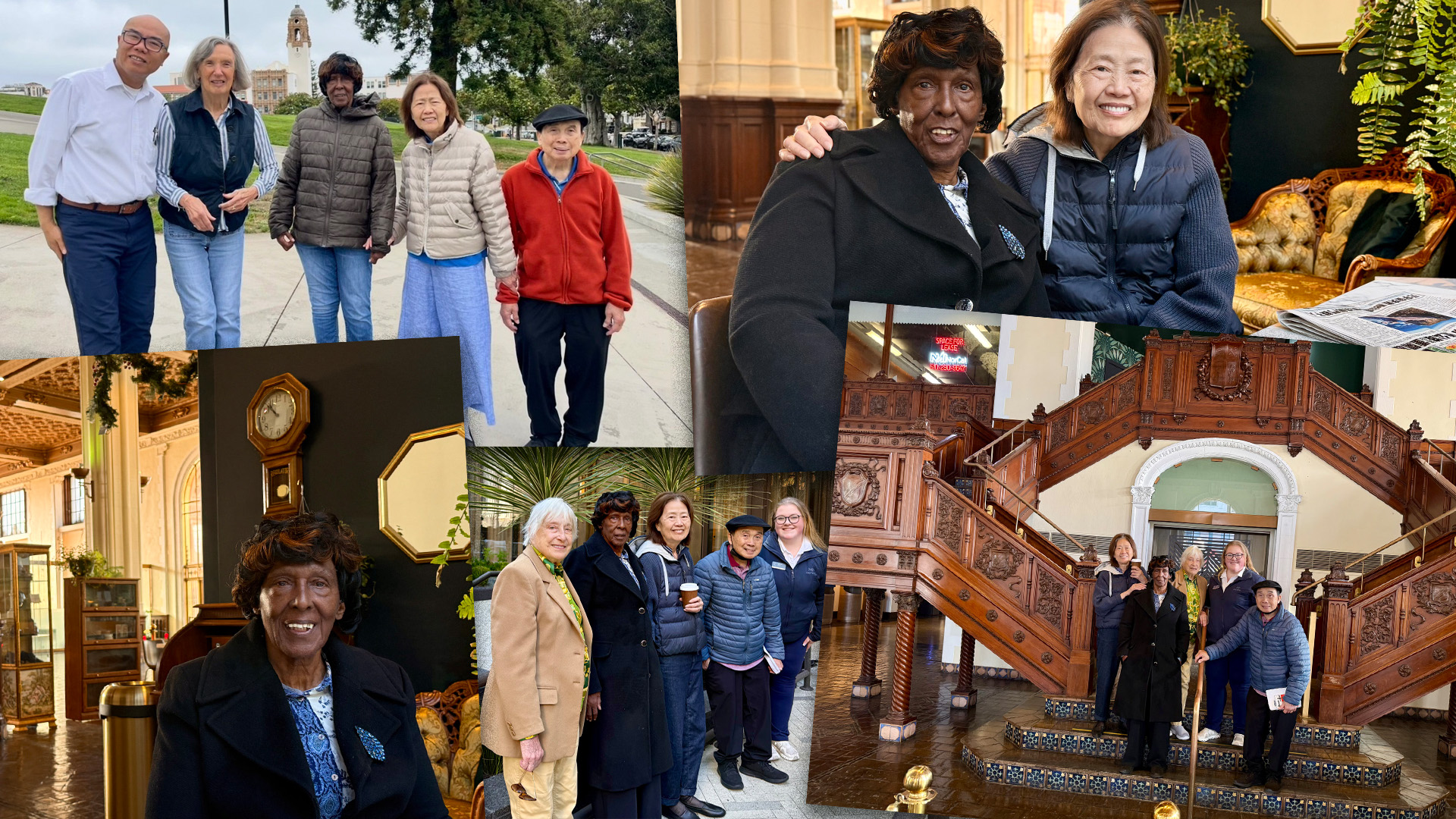
Samantha Curro, Memory Care Director at Coterie Cathedral Hill, explains the philosophy behind it. “We really want our residents to continue living rich, meaningful, fun lives while also getting an elevated level of care.” That commitment shows up in daily programs—live music five days a week, regular cultural outings, and themed celebrations.
But what truly set Coterie apart was its approach to group excursions. Unlike most communities they visited, Coterie actively includes memory care residents in outings whenever possible.
“We looked at facilities where they had vans for everybody to go out except the memory care floor,” Rittinell says. “Here, the memory care residents can participate. These are the things we wanted for her while she’s capable of enjoying them.”
Coterie’s approach aligned with what the sisters had been searching for all along: excellent care, thoughtful design, and genuine human connection.
Thriving in Memory Care at Coterie
Nearly a year after Daisy moved in at Coterie Cathedral Hill, her doctors report that she is in good physical health for her age and that her Alzheimer’s symptoms have remained stable, with no significant deterioration in cognitive function. She still has moments of disorientation or fatigue, but these existed long before she arrived at Coterie.
What has changed is her quality of life.
The sisters are grateful to Curro and her staff for maintaining a welcoming memory care environment.
“I really like how the Memory Care Director has been very accessible to us if we have questions or want to set up a time to visit,” Elaine says. “She’s just been wonderful. It’s nice to have that connection and to feel heard and respected.”
For her part, Curro credits Daisy’s family for visiting frequently and being actively involved in her life.
“Daisy has a beautiful family, and you can really feel the bond and affection they share with their mom,” Curro says. “Daisy’s such a wonderful part of our community, and I appreciate them trusting us and sharing her with me and our memory care team.”
The sisters are no longer surprised to find Daisy taking her regular hallway walks with other residents. In fact, her walks have become a staple of her routine.
“She was in the hall walking with some of the ladies,” Rittinell says. “And she saw me. I said, ‘Mom, what are you doing?’ She goes, ‘Walking with my friends.’ That was a very wonderful moment for me. And then she kept walking.”
You might also like
Want to learn more about life at Coterie?